Academic planning shouldn’t require knowing the system already.
AtlasOne helps high school students understand their progress,
explore course requests, and bring their families into the
conversation.
A course request starts a conversation with a counselor. It is
not an enrollment or a final schedule.
Algebra II
Conditional on passing Geometry
Chemistry
Ready to request · Biology completed
Keep a person in the loop
The request becomes a conversation.
In the actual app, counselors review requests, maintain
transcripts, and message students and linked families.
Requests in this example
No requests yet. Try requesting a class from the Student
view.
This illustration shows pending requests only. The full app
scopes counselor access by district or assignment.
Make the plan understandable
A shared starting point.
Parents see explicitly linked students. Plain-language
explanations help make credits and prerequisites part of a
useful conversation.
Avery’s progress, explained
Avery has earned 1 of the 3 math credits in this example.
Geometry is still in progress. Algebra II can be requested for
next year if Geometry is passed.
Preset English and Spanish text for this illustration. In the
full project, broader conversational translation and parent
read-aloud use optional Gemini services.
02 / The thinking behind it
Rules first. Clarity alongside them.
01 / Input
Student record
Coursework, earned credits, district requirements, and
prerequisites.
02 / Deterministic logic
Academic rules
Python calculates progress and checks the conditions for course
requests.
03 / Optional assistance
Understand the plan
Gemini explains academic context; it does not decide earned
credits or eligibility.
The engineering
Connected workflows.
I built relational data models, Django authentication and
validation, personalized dashboards, and a PDF transcript parser.
The current parser proposes rows for counselor review from a
supported table layout.
The application connects student requests, counselor review, and
family-facing explanations through scoped access to academic
records.
The purpose
Guidance that more families can use.
AtlasOne is designed with lower-income communities and families
navigating unfamiliar school systems in mind. Clear progress,
explanations of school terminology, and optional translation can
create a better starting point for asking for help.
These are design goals. Usability, language quality, and
educational outcomes still need evaluation with students,
families, and schools.
What works locally, and what uses AI?
Graduation calculations, prerequisite checks, and rule-based
summaries run without an API key. The local fallback has limited
preset translations. Gemini adds conversational explanations,
requested-language support, and optional parent text-to-speech when
configured in the Django application. The portfolio demonstration
above uses neither Gemini nor a school database.
Graduation feasibility is a heuristic estimate, not an optimal
timetable solver. Final academic decisions belong with the school.
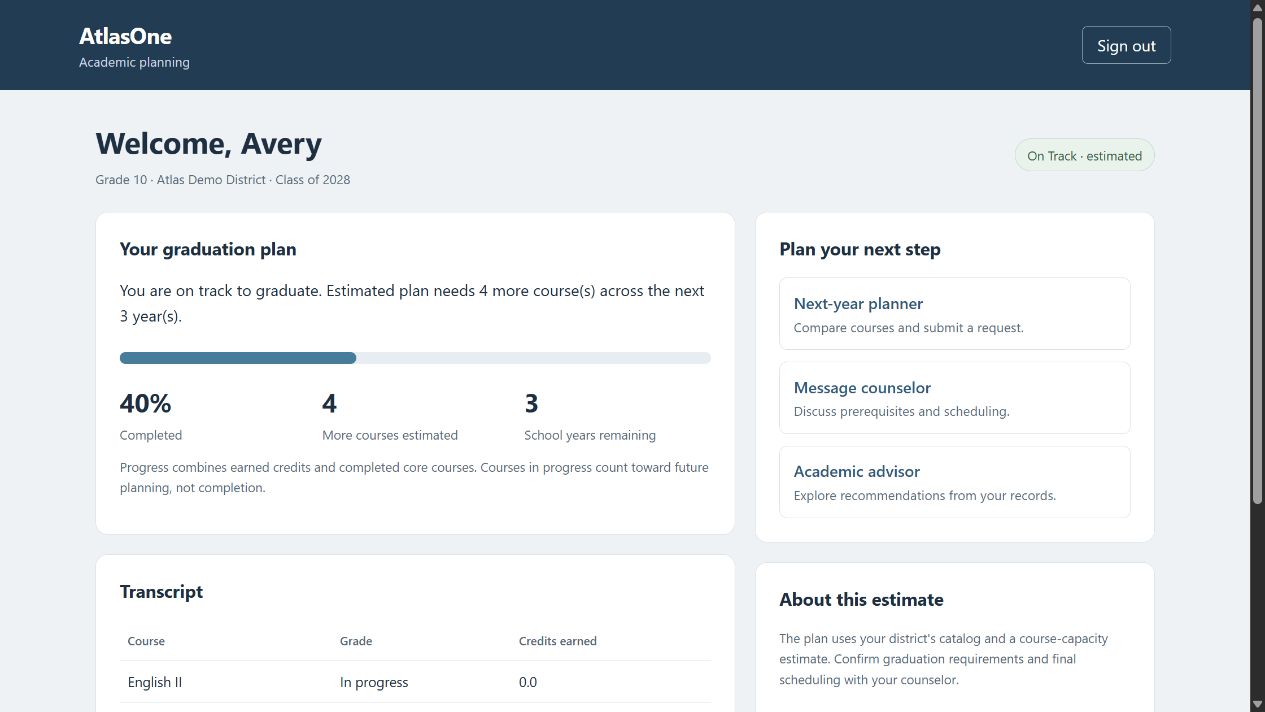
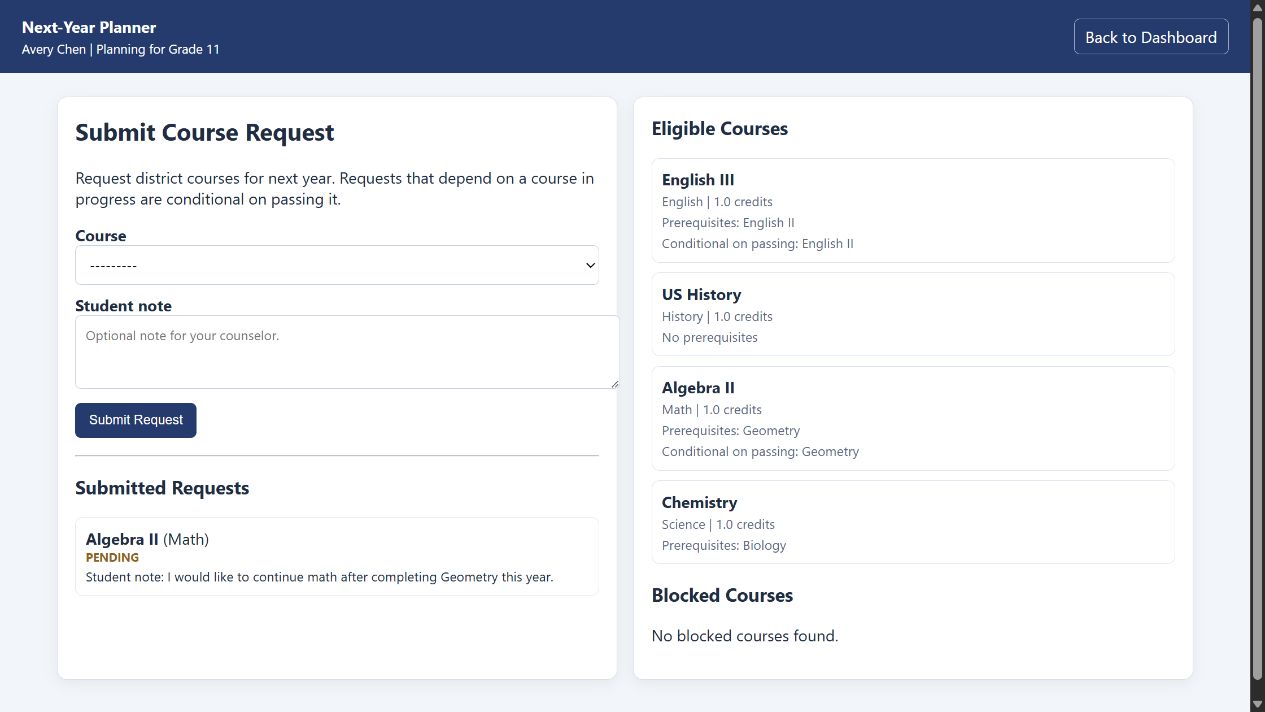
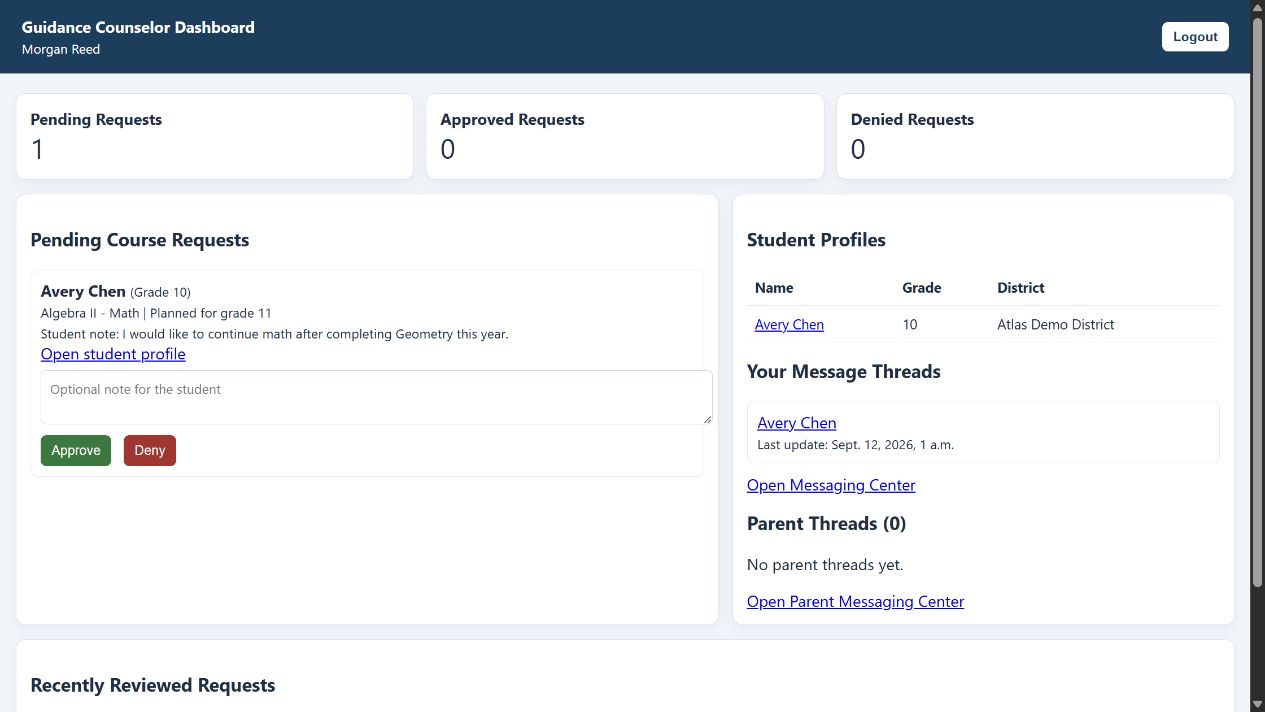
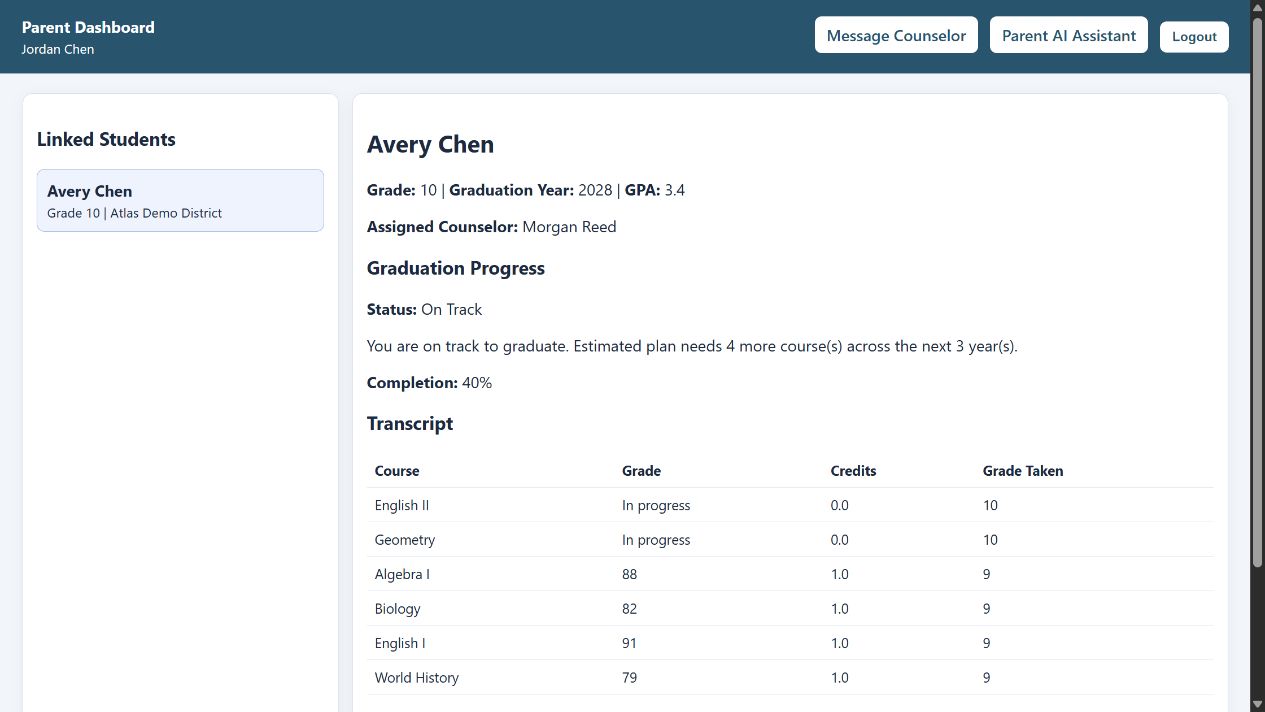
Real application screens with fictional demo records.
01 / The student dashboard
A clearer view of progress and possible next steps.
02 / The planner
Understand the requirements behind each choice.
03 / The counselor
Keep requests and student context together.
04 / The family
Bring parents and guardians into the conversation.
Features, architecture, and application screenshots:
AtlasOne repository, reviewed September 15, 2026. The interactive planner is a
simplified illustration; it does not reproduce the full graduation
estimator.